This BitStrip was created for my Intro to Literature class. I create this to give a more visual affect of the story Independence by Chuang Tzu. The link on the title will take you to a copy of the actual piece that I found through Google.
I used a site called BitStrip to create my piece here. This is a really cool site because it has built in characters, settings, captions, speech bubbles, and props. The only thing within this piece I had to create was the turtle. I actually created this in about five hours. So it was a little time consuming considering the little work that is shown here and how long the piece actually is. But it was a fun site to use and it was neat to put the story into a different format.
So I may be behind in this neat little invention but I saw it on Facebook and had to share it.
When I was younger my mom had this cool cup that if you poured a hot liquid into it, the cup changed. It originally would say "I love you" around the top, but with a warm liquid the cup would then show the image of the phrase in Sign Language.
Well, this idea has been transformed by Harry Potter fans. A Mischief Managed Heat Transformation Mug has come on the market! Take a look here!
If you would like to buy this mug follow this Link.
I thought this was really neat because it brings to life the magical world of Harry Potter. While it may not actually be magic, I know that it feels like magic when you're a kid. My mom's "I love you" mug was my favorite whenever we had hot chocolate because it made it feel magical. To not only incorporate the words but also the magical theme of the series into this mug brings a whole new level of awesome to this product!
It has always been clear that
Ivanhoe, Minn. was named after Sir Walter Scott's novel, Ivanhoe; however,it is not so clear where the suggestion first originated or the specific
connections that lie between the town and the novel.
A new wikia page, now accessible online, called Literary Connections:
Ivanhoe and Ivanhoe helps to enlighten the public.
"I was intrigued by the connections I saw while reading Scott’s novel,"
says Brittany Vlaminck, creator of Literary Connections: Ivanhoe and Ivanhoe
and native of Ivanhoe, Minn. "It gives my hometown a deeper meaning that I
wanted to share with the public." Vlaminck shares that this sparked the
idea for the project.
After reading Scott’s novel, Vlaminck researched the town’s history at the
public library in Ivanhoe, Minn. After this, she traveled the town to find
literary connections that can be noted between the town’s streets and benches
and Scott’s novel. This information can be found on Wikia.com.
“Ivanhoe is actually named after an estate owned by a knight named Wilfred,
this creates the mental image that the favored knight comes from the town in
Southwest Minnesota,” says Vlaminck. Information like this can be found with in
the 21 pages about how the town's name and nickname came to be and their
connections to the novel. It also shares information about the characters and
places the town's streets and benches of Harthill Walk are named after.
IZombie, a new CW show, was first introduced to the public on March 17th, 2015. The show follows the life, or rather living death, of Olivia "Liv" Moore played by Rose McIver. This character is a young woman who was turned into a zombie when, at a party, was scratched by a fellow zombie. The show starts five months after the incident. Her live has been turned upside down because of this change, including her career choices, her love life and her eating habits.
Liv has gained an ability that allows her access to memories, habits and abilities of the people whose brains she consumes. Because of this, mixed with her access to the brains of murder victims through her job as a mortician assistant, she becomes the assistant to a cop that looks into these murders.
This show, created by Rob Thomas and producer Diane Ruggiero, is a loose adaptation of the comic book, iZombie, written by Chris Roberson and illustrated by Michael Allred.
The comic book's main character is Gwendolyn Dylan, a 20-something grave-digging zombie, whose best friends are a ghost and a were-terrier. Gwen also has the ability to gain access to memories, habits and abilities of the different people through the consumption of their brains. She, just like in the show, uses this ability to help solve murder cases of the people whose brains she has consumed.
The original version consists of many introductions to supernatural characters, including zombies, ghosts, were-terriers, and vampires.
While the two versions of the story differ greatly, we can still see that the underlining idea of the original story is present across these two medias. Both of these stories are showing a young woman living life as a crime fighting zombie.
I'm normally not a fan of when new medias change much of the original story, but I do like what CW has going and I'm hoping they start to incorporate more of the original plot by adding in other supernatural beings.
I recently read a section of a book called "Play Between Worlds" by T. L. Taylor. The section, or rather chapter, was entitled "Where The Women Are" and the chapter discussed how women have become very common players in the gaming world. While the chapter focuses on women who play Everquest, it can be said, for almost any game, that women have become common and valuable to gaming culture. So if this is becoming so common, why are we still focusing our advertising strategies towards men?
The following link will take you to a paper I wrote for my Contemporary Rhetoric class that discusses the advertising strategies of this game and how new media allows easier access to these advertisements.
So, originally I had started a blog post today to discuss some video game advertisements I had seen recently. When I opened up YouTube to grab links to the video game advertisements, I was recommended to a video that looked really interesting. I opened it, and THREE AND A HALF HOURS LATER I finally closed YouTube up. And yet in those three and a half hours, I never made it to the video game advertisements I had been looking for.
I have no idea how many videos I watched during this time, and to tell you the truth, I don't remember what they were all about. But during this time, I remember feeling extremely hungry and not being able to put my computer down. I was so intrigued and entertained that it made it hard to look away.
When I finally closed YouTube and looked at the two paragraphs I had originally started, I dreaded the idea of going back to YouTube for fear that this would happen again. This is not the first time I have diverged into binge watching when I was supposed to be doing something important, and it probably won't be the last.
I started thinking about all of those videos that were created by the same users.Here are some of my favorite YouTube channels that are consistently adding new videos:
An article from CelebrityNetWorth, called 25 Highest Earning YouTube Stars, estimated (in 2013) that the annual income that Jenna Marbles makes is about $4.3 million, while CollegeHumor only makes about $3.3 million. BuzzFeed isn't even on this list but it's likely that it is also making a fairly good sum from their YouTube channels.
It was amazing to me to see this because these people have made careers using this new new media. They have established a fan base that continues to grow and change, but the truth is that as long as they keep posting, there will likely always be that fan base for the information they offer. It's inspirational to see these channels succeeding to the point of making millions for simply getting views.
The study of English is a study of the way we communicate with the world
through language and shared stories and that's exactly what YouTube
allows us to do - share stories. JennaMarbles has been sharing her life story for over four years. She has introduced the public to her family, friends, boyfriends and pets. CollegeHumor has shared knowledge and stories that are focused on the humorous thoughts and situations we deal with in college or around that time frame of our lives. BuzzFeed tells stories, shares information and discusses serious topics. All of these stories can be experienced over and over again the same way we can experience literature over and over again. YouTube just allows us to experience these stories in a different format than classical literature.
One last thing I'd like to note is that since all of the videos are like little stories, and because they are all within this larger frame that is YouTube, we can consider YouTube a Frame Narrative!! Woah! Mind Blown!
Just visited Ivanhoe, MN to do some research for my Foundations project.
The plan right now is to created a new media project that shows the connections that can be found between Ivanhoe, MN and Ivanhoe by Sir Walter Scott. Thanks to the help of Sue Vizecky, one of the Ivanhoe Public Library librarians, I have many leads and avenues that I can use to create this project. But with it being due in a little over a week, I know I have my work cut out for me.
Wish me luck! There will be more to come as the project comes into being! :)
In my Short Stories class a few weeks ago, we were discussing a few short stories and my professor introduced us to this really cool website called LitGenius. Originally, the site was created to share song lyrics written by well anyone, but it has become a place where people create annotation about stories that they know and love.
How it works:
You create a profile, and you search for your favorite story or for a story where you discovered something really cool within the text of that story. If you find it you go to a section where you discovered that really cool think and you comment on it. In the comment you can add pictures and links to help explain your point. This comment is then considered an annotation.
You can also vote annotations up or down depending on if you thought the comment was helpful. You comment on the annotation to tell why you agree or disagree with it, or you can suggest to the author to edit the original annotation so that it explains what they were trying to say more efficiently.
If you can't find the story you searched for it's really easy to add it so you can share your discovery with others and so others can share discoveries they've made while reading the piece.
Why this is so cool!:
This site is really neat because it allows people of all walks of life to share and discuss their favorite stories. It creates the opportunity for people to look more critically at a piece and to share their discoveries.
This new media site also allows easy access for people to discover new stories that have been written and they can see what other people have said about the story while they experience the story themselves. I think this is important, especially for stories that can be hard to understand, because it allows us to give specific details about what the author meant and how the words can have different meanings today that can help create different readings of the story.
Some Examples:
Shakespeare's "Sonnet 130: My mistress' eyes are nothing like the sun"
This is honestly my favorite Shakespeare sonnet, and to find an annotated version is interesting because it allows me the opportunity to see what others have said about it.
Joseph Conrad's "Youth"
This was the first piece that we, as a class, worked on together. We each had to create an annotation within the piece.
Carolyn Kizer's "Bitch"
I studied this piece in my Intro to Literature class and found there were two meanings to the word "mistress" and knowing there were two definitions to the term "bitch", made this a really interesting piece in my eyes and I wanted to see what others have said about it!
For my short stories genre class, I created a presentation about Oscar Wilde's short story, "The Nightingale and The Rose". The presentation was to show different adaptations that have been created of the work. The presentation has information about Wilde and his life, a summary of the story and some of the themes within the story. It discusses some of the styles used by Wilde and then it goes into the adaptations. These include a ballet and opera and also different videos that I have linked within the presentation.
The first page covers information about his life and family and what he wrote. Both of his parents were writer, which ultimately sparked Oscar's interest. He married a woman named Constance Lloyd and had two sons. He later began an affair with Lord Alfred Douglas and was arrested for the affair shortly after. He died due to a severe ear infection that turned into meningitis.
He created many works including a book of poems called Poems. Two short story compilations, of which The Nightingale and the Rose can be found within Happy Prince and Other Tales. He wrote one novel that had been first published as a short story but was edited and republished when his critics asked for a longer story. He also created many well known plays.
SPOILER ALERT! The story is about a young student who is in love with the daughter of his professor. She says she will dance with him at the ball the following night if he can bring her a red rose. The student does not have a red rose in his garden and the nightingale hears his cry. She searched the garden and talks to the different rose bushes until she comes to a red rose bush that says he can produce a red rose only if she is willing to sing to him all through the night while pressing her heart into a thorn in the bush. SPOILER ALERT!! The nightingale agrees to do this in the name of true love. In the morning, the student walks over the nightingale's dead body and pick the red rose. When he presents it to the young girl, she refuses because the chamberlain's nephew has given her jewels. The student throws the rose into a gutter and it is run over by a cart while the student goes back to his home to study. SPOILER... well, too late if you already read through this.
Wilde's style has a lot of recurring devices and themes. Some of these are pointed out in this show with excerpts of where they can be found in the piece.
ADAPTATIONS!!!
Some adaptations that were created include the ballet and the opera. The ballet slide has a link to a video from the backstage of the production. The ballerinas and the creator talk about the adaptation because there it was difficult to create the production. Since ballets use only music and dance to convey a story, and Wilde's story use lots of dialogue, it was important for the audience to read the leaflets before the ballet began to understand the story fully. The opera was a compilation of Wilde's story and four poems from Christina Rossetti.
Other adaptations have been created that can be found on YouTube. The slideshow links to a couple of these videos.
For another class, me and a group of my peers are looking to create a project for our Contemporary Rhetoric class. We were discussing our audience, and since the prompt suggested targeting our generation, I started looking into Generation Y.
This generation normally consists of individuals that were born between the 1980s and the 2000s. It is also called the Millennium Generation, the Echo Boomers, and IGen, or Internet Generation.
An article found on About Careers.com called Generation Y by Sarah Kane says that the most common traits of the individuals from generation Y is that they are tech-savvy, family-centric, team oriented, achievement oriented, and attention-craving.
Agree: I was intrigued. It is well known that our generation has grown up using a wide variety of different mediums, making the tech-savvy observation likely to be correct. And thinking about how this group project has already been going, I can see that every one in my group (all of which are members of the Y Generation) is also very team and achievement-oriented because they are working together to create a proposal and to create a full proof plan on how to attack this project. We have also already planned future meetings to keep updated with each others work so that this is a group effort rather than individual work. This idea of attention-craving suggested more that we like praise and feedback on our work. We want to offer the best work we possibly can because that is what our generation has always been told to do. "Do your best." And because we have this desire, we look for someone to tell us whether they think we did well or if we could have done better.
To Disagree: The only trait in this list that I feel any disagreement with is this idea that our generation is family-centric. I'm not saying that we aren't just that I believe there is a better way to describe this trait. Personally, I am very family oriented, but the reason I like a flexible schedule (as the article suggests) is because there are many things I want to do with my life outside of work. I believe it's important to have a job to provide for our families and our lifestyles, but I have things I want to learn and to be a part of outside of my job. As I'm looking into a career of editing, I'm thinking to myself about my desire to travel to all fifty states, and to become a sommelier, and to own a stylish wardrobe made of dresses and giant sweaters and far too many pairs of leggings. I want to read the Classics of different time periods and locations, and to compare them to the novels that are now being created today. These are all activities that I need free time to be able to do. I feel that our generation focuses so much on Internet and other mediums because they offer us the ability to communicate, write, read, work - all while on the go. We can share information easily through these new medias and we have the ability to learn new things with just a few clicks of the buttons on keyboards and touch screens. This ability is what we crave because it offers us the option of having free time to see the things we want to see and do the things we want to do while keeping a job and earning that living that is so important in our survival. Back to the Top: So back to the different traits that describe this generation - I feel that the phrase "family-centric" is the wrong word choice. I feel that the trait they are trying to describe here is "Self Indulging". We believe in an understanding of balance of life between work and fun. We allow ourselves to enjoy life whether that means focusing more time on our families or focusing on goals outside of our work and home lives, we let ourselves indulge on the pleasures that life has to offer. This discussion shows the connection between English and New Media because it is an article that a writer created that was offered to the public in this medium to reach a large mass of people. Anyone who wanted to know about Generation Y had the ability to find this knowledge by just a few clicks of the keyboard or screen. New media has allowed us to find information faster than before. It also allows us to share our thoughts of the things we read and experience the way this blog is allowing me to share my thoughts after reading Ms. Kane's article.
I have always had a fascination with Japanese manga, from when I was really in my younger teens I was always checking out manga books from the library or searching YouTube to watch different anime cartoons and to see the animation that they use compared to how we create it here in America.
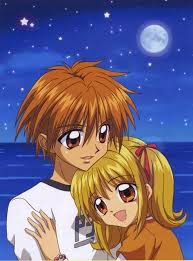
My favorite manga is one called Pichi Pichi Pitch: Mermaid Melody created by Michiko Yokote. It is about the seven mermaid princesses that were the guardians of the seven seas. It focused on one princess in particular, Luchia, because she was coming into adulthood and had fallen in love with a human boy, Kiato. It was forbidden, but the princess continued to kind of "woo" Kaito.
Kaito and Luchia
Unfortunately, her true form and the monsters that were trying to capture the princesses created complications for the couple. I have not finished the series, so don't spoil it for me.
Luchia's Different Forms (Human, Mermaid, Warrior)
Various Mermaid Melody Villains
How I stumbled on the story is kind of interesting. I had been watching music videos on YouTube that showed animation clips from different cartoons. One of the clips showeda mermaid and a young man together. It caught my attention so I looked into the list of cartoons the creator had used and found Mermaid Melody listed among them. I investigated into the cartoon and found episodes of the anime on YouTube.
During my youth I was only able to find episodes that were in Japanese with English subtitles. I was also able to find similar versions with French or Spanish subtitles, instead.
But recently, I was able to find versions that have voice overs in English, French, Spanish and even Greek, which you can see below, respectively.
I knew the anime was based off of the manga, but I hadn't really looked for it. One Christmas morning, sitting in my stocking, I found an English copy of the first volume of Pichi Pichi Pitch: Mermaid Melody! I was so excited! I have plans to buy the other six in the series and to finish watching the anime on YouTube when I can find all of the episodes.
I found it really interesting how over the course of ten years the manga was created and published in its original form, was translated and published in other languages, and then became an anime that has been recreated by YouTube-ers to have not only subbed versions, but dubbed versions, as well. It is so neat how new medias have allowed the public to not only share stories internationally but how they can be recreated, or changed so that a new audience can understand them in their own languages.
Changes like these also show us back to that idea that "Medium is the Message", because of the different formats this story was created in.
In its original form, its message was meant to reach Japanese individuals for entertainment purposes, then when the English versions came out, it was given the chance to reach a wider audience. It's possible there are other languages the manga came out in, I am just unaware of them at this time.
When the anime version came, it was meant for the content of the story to be shared in an easier format because people no longer needed to read a whole book, but they could watch half hour episodes that breaks the story down.This version was meant to stay specifically in Japanese. The creators did not have plans to create it in English or any other language. But YouTube-ers had different plans. Because these people created versions of subbed and dubbed episodes, the message had now been changed again to allow a wider audience to enjoy the story in the new format.
In class today, we were asked to look at our stats page on our blogs. I looked at it from when I first started it to it's current status. I find it really interesting, but there's nothing too exciting to note.
I feel like my page views are really high, but I've noticed that even my own visits are counted in that number, so a lot of those views are my own. I check the blog to make sure the links work right and that everything aligns right and such.
February 2015 page views.
This picture shows my page views specifically for the month of February of this year. This is very different from the all time page view status because it shows that there was a bit of activity in February, but the picture looks like there wasn't much activity. As you can see here the most used day was sometime around the 19th and at that time I had 15 views. Whether these are all my views or from others, I'm not quite sure. But it's really neat to see.
Back to the first screenshot of all of my stats, it's cool to notice how many people have viewed the individual posts, while I know that at least one of those is from me, it's neat to know that four others have looked at my post on 2nd Street Diner. I hope that my post about Wine-ing in SD gets more attention because it has a link to my pinterest page that offers information and links of the different wineries around South Dakota! I think this is such a neat subject because while wine is a world-wide product, SD wines are made to show the best of South Dakota! They use fruits and grapes that grow naturally in the state. I feel like this is a subject of interest and that people may like that post if they were to see it.
The audience was interesting because it's just in the US. But a blog allows access for other countries around the world. My current audience, I assume, is mostly just my classmates but searching the internet allows opportunity to find my blog and posts.
I was at the theater this weekend to see Kingsman. (Btw great movie!!!) During the commercials, there was a new horror movie being advertised. I was very intrigued by it because it put a twist on the usual horror film.
The film is based on a group of students having a conversation on Skype about a friend that had passed away. A video had been posted on YouTube about this friend and the results from the cyber-bullying that occurred affected the girl enough for her to commit suicide shortly afterwards.
As the group talks they notice an extra viewer, or Skype-er as we'll call that person, within the conversation and they start to question who it is and why that person is part of the conversation. The extra Skype-er starts to harass the students to find out who had posted the video. As the movie goes on some of the students die by the hand of this extra Skype-er.
This is the official trailer for the movie. It was posted on YouTube on January 13th, 2015 and as of today (February 18th, 2015) has received over 5 million views. The movie is said to arrive in theaters on April 17th, 2015.
In case there are people reading this that don't understand what Skype is, it is a program that allows people to message, call, and video chat with people. It is a free program that connects people all over the world and allows them the benefit of seeing each other physically even though they cannot touch each other.
With the opportunities that new medias allow for us, the general public, it brings to light that our safety and privacy are now, more than ever, harder to protect because it is so easy to find almost anything online. Even if you're not the one posting them.
The video of the girl, Laura Barns, left an everlasting impression of her to the rest of the world that she was never going to be able to escape. This video was not approved by her, posted by her or even taken by her. She had no ability to control whether this was put out into the World Wide Web, nor did she have the ability to take it down and destroy it. In the end, as cliche as it sounds, this video destroyed her and all of the friends that were involved in the making and posting of it.
The way a message is shown and/ or shared with the general public - the medium in which the message is shared is a message in itself.
There are so many different types of mediums that we have the opportunity to use: from old media to new medias like books and newspapers, oral stories, essays, poems, television programs, movies, music, social medias, blogs, video games - all of these different mediums have a way of reaching the public in a different way, they're also meant to reach different audiences.
When studying stories in class, I have noticed that there are so many options to learn about the story. I can find where the story first comes from and I can look for physical copies through those books. I can find an electronic version and read it straight from my computer, nook or phone. I can also look for videos of audio readings, whether it's from a tape or from YouTube. I can also find movies about the story or based off of the events and characters in the story. There are so many options to find this one story.
The thing about all of these different mediums is that there's a new message being sent because of the change in the original. The physical version, the original medium (normally), says "You need to work to find this book and take time to read this book to get this story." While audios found online say "as long as you stumble upon me, you can clean, drive, and do other activities while getting this story." Videos say "Hey we're gonna cut the time you spend reading or listening to this story in half and engage new senses to show you the story."
But these different mediums can also change the story. When we read the story from its original medium we get the personal feeling of how the story was meant to be shared but once you start to listen to the story or watch videos, the story changes because the person creating and sharing the new medium may perceive and display the story in a new way than it was originally intended to.
New mediums are meant to make it more available for the general public, the audience, to get the story. But they do change the original message and the original story.
I just finished pulling together my English for New Media Text Project. I decided to do a little video showing how the top ten languages used around the world write the phrase "English for New Media". You can either watch the video here from YouTube, or you can follow the "Check it out!" link that will take you to Wideo, where the video was originally created.
Side Note: I could not find Hindustani on the Google Translator, but I did find that the language is based from two different languages - Hindi and Urdu. I substituted the way these languages write the phrase for the Hindustani section.